The beauty industry is undergoing rapid evolution, and salon proprietors can no longer depend on antiquated systems. Ranging from small studios to expansive spa chains with multiple locations, enterprises are substituting manual procedures with intelligent digital platforms that effectively handle appointments, billing, personnel, and customer information.
Manual systems have evolved from being merely inconvenient to becoming a significant financial burden. Missed appointments lead to a decrease in revenue, while paper records are prone to errors, and disorganized workflows cause frustration for both employees and clients. In a fiercely competitive market where customer experience is paramount to success, the use of outdated tools can subtly drive loyal customers to seek out competitors that are better equipped.
The demand for automation is increasing rapidly, and by 2026, AI-driven salon solutions will be necessary rather than merely optional. Those who adopt these technologies early will secure a distinct advantage in both operations and revenue.
At DevStory, we have assisted beauty enterprises at all stages of their growth. The cost to make salon app development in 2026 generally varies from $15,000 to over $120,000, influenced by features, platform selection, and AI integration. Knowing these elements is crucial for making informed investment decisions.
What is Salon Management Software?
At its essence, salon management software serves as a digital platform aimed at automating and optimizing the daily operations of a beauty enterprise. Consider it a central hub that manages appointments, employee schedules, client information, transactions, and marketing efforts — all from a single location.
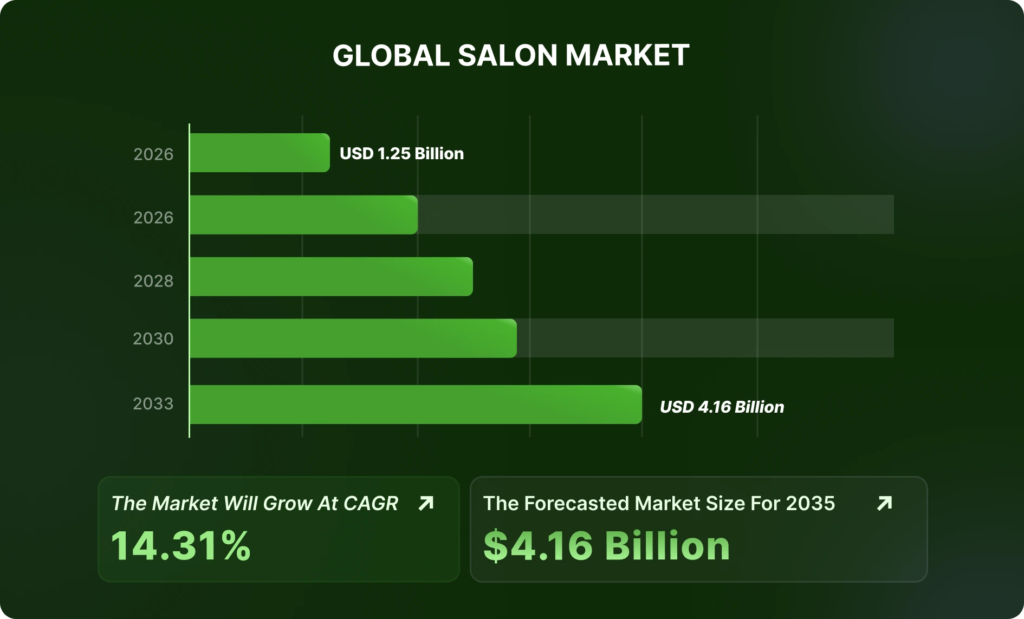
The salon management software market is growing steadily, rising from $1.24 billion in 2025 to $1.36 billion in 2026. It is expected to reach $1.97 billion by 2030, driven by cloud adoption, personalization, analytics, and increasing demand from small salons.
Without it, salons face a common array of challenges. Clients often forget their appointments, and there is a lack of follow-up. Billing processes are handled manually, resulting in errors and delays. Customer preferences and visit records are kept in someone’s memory instead of being stored in a searchable database. These are not minor inconveniences — they represent significant revenue losses.
The solution is effective for businesses of various sizes. A single-location salon requires fundamental scheduling and point-of-sale capabilities. In contrast, a multi-branch chain needs centralized reporting, staff management across different locations, and real-time inventory tracking. High-end spas necessitate membership management, loyalty programs, and tailored customer experiences. The development of salon management software caters to all these situations based on the specific scope and construction of the product.
In 2026, as client expectations evolve towards digital-first experiences — including online booking, immediate confirmations, and tailored recommendations — possessing the appropriate software is not merely a convenience. It is the fundamental requirement for maintaining competitiveness.
Core Features That Decide the Cost
The selection of features you make is the primary factor influencing the cost of developing your salon management software. Below is a practical overview of the components that constitute a contemporary salon platform.
Basic Features
Appointment Booking
A calendar system that lets customers book, reschedule, or cancel appointments without calling the front desk. Simple on the surface, but it requires real-time availability logic and conflict prevention under the hood.
Customer Database
A centralized profile for every client, storing contact info, visit history, preferred services, and allergist notes. This is the backbone of personalization.
Staff Scheduling
Tools for managing employee shifts, assigning appointments to specific stylists, and tracking working hours. Reduces the back-and-forth that wastes time every morning.
Billing & POS
Integrated point-of-sale functionality that handles invoices, accepts multiple payment methods, and generates receipts automatically. When connected to the appointment system, it eliminates manual billing entirely.
Notifications
Automated SMS and email reminders sent to clients before appointments. This one feature alone significantly reduces no-shows, which directly impacts revenue.
The selection of features you make is the primary factor influencing the cost of developing your salon management software. Below is a practical overview of the components that constitute a contemporary salon platform.
Advanced Features
Online Booking App
A dedicated mobile application that allows clients to browse services, check stylist availability, and book in real time. A major expectation among younger clientele in 2026.
Inventory Management
Tracking product stock levels, setting reorder alerts, and connecting inventory consumption to services delivered. Essential for salons that retail products alongside services.
Loyalty Programs
Points systems, membership tiers, referral rewards, and birthday offers that keep clients coming back. A well-designed loyalty module can measurably improve retention rates.
Analytics Dashboard
Visual reports on revenue, peak hours, staff performance, service popularity, and customer lifetime value. Turns raw data into decisions.
Multi-Location Management
A single dashboard that oversees operations across multiple branches, with centralized reporting and location-specific controls. Critical for chains and franchises.
Even fundamental features entail significant development effort. A booking system equipped with conflict resolution, a real-time customer database, automated notifications, and a unified POS system are not straightforward implementations — collectively, they constitute the foundation of your salon application development expenses and establish the quality standard for all subsequent developments.
AI Features in Salon Management Software
The beauty industry is embracing artificial intelligence faster than most people realize — and if you’re planning to build a salon platform in 2026, AI is likely already on your feature wishlist. But want to know how AI features increase salon app development cost while simultaneously delivering the highest return on investment? This section breaks it down clearly. Artificial intelligence is no longer reserved for tech giants. In 2026, AI is being embedded into salon platforms in ways that directly solve real business problems — and you don’t need to understand the technology to benefit from it.
AI-Powered Smart Scheduling
Instead of just showing available time slots, AI analyzes booking patterns, stylist performance times, and client preferences to suggest the optimal appointment slot for everyone involved. It reduces schedule gaps, balances staff workload, and maximizes daily capacity — all without any manual intervention from your team. This feature adds $8,000 to $15,000 to your salon management software development cost.
No-Show Prediction and Automated Reminders
AI monitors client behavior — cancellation history, reminder response rates, booking patterns — and flags high-risk appointments before they become no-shows. The system automatically sends targeted follow-ups to unreliable clients while leaving dependable ones alone. This proactive approach quietly recovers lost revenue every single day. Expect this to add $6,000 to $12,000 to your salon app development cost.
Personalized Service Recommendations
Every client visit teaches the system something new. Over time, AI recommends services each client is statistically likely to enjoy, based on their history and similar customer profiles. It feels like white-glove service to the client — but it runs entirely on data. This capability adds $7,000 to $14,000 to the cost to make salon app development more intelligent.
AI Chatbot for 24/7 Booking
A salon-trained chatbot handles booking inquiries, answers common questions, confirms appointments, and collects client details around the clock — with zero staff involvement. Clients browsing at midnight can book for the next morning without waiting. Integrating a capable chatbot adds $5,000 to $10,000 to your overall salon management software development cost.
Smart Marketing Automation
AI identifies the perfect moment to reach each client. Lapsed visitors get win-back offers. Clients due for a treatment get timely nudges. Every campaign becomes hyper-targeted rather than generic, driving higher open rates and more repeat bookings with less manual effort. This adds $5,000 to $10,000 to your salon management software development cost.
Revenue and Demand Forecasting
AI analyzes historical bookings, seasonal trends, and local patterns to predict busy periods weeks ahead. Owners can adjust staffing, stock inventory, and launch promotions at precisely the right moment — replacing reactive guesswork with confident, data-backed planning. Forecasting tools add $8,000 to $15,000 to the cost to make salon app development enterprise-ready.
AI features are a significant contributor to salon app development cost, but they deliver compounding value: more bookings, less staff workload, and stronger client retention — all simultaneously. Want to know which AI features make the most sense for your salon business? Get in touch with DevStory — we’ll help you identify the right tools, avoid unnecessary costs, and build only what drives real results.
How Much Does It Cost to Develop Salon Management Software in 2026?
Comprehending the expenses associated with salon app development necessitates an examination of the market in tiers. There is no uniform price point, as the product designed for a boutique studio significantly differs from the needs of a national chain. Below is a breakdown of costs for the year 2026.
| Feature | Estimated Cost | Best For | Development Timeline |
|---|
| Basic Software | $15,000 – $30,000 | Single-location salons | 3 – 5 months |
| Mid-Level Solution | $30,000 – $60,000 | Growing salons & multi-service spas | 5 – 8 months |
| Advance-Level Solution | $60,000 – $120,000+ | Multi-branch chains & franchises | 8 – 14 months |
Tier 1 — Basic Software: $15,000 – $30,000
Created for small, single-location salons aiming to transition from manual systems while keeping things straightforward. This tier usually includes appointment scheduling, a customer database, staff management, basic point of sale, and SMS alerts. It is typically web-based or a straightforward mobile application, designed with standard features and lacking AI functionalities. Development timelines typically range from 3 to 5 months. This serves as an ideal initial step for salons looking to digitize their operations without a significant upfront investment.
Tier 2 — Mid-Level Solution: $30,000 – $60,000
This range is the most sought-after for expanding salons and multi-service spas. At this tier, you receive a comprehensive mobile application in addition to the web platform, loyalty programs, inventory management, payment gateway integrations, analytics reporting, and the capability to oversee a second or third location. There is a greater investment in UI/UX, resulting in a refined experience, and third-party integrations — including Google Calendar, Stripe, or email marketing tools — are incorporated. The development process generally spans 5 to 8 months.
Tier 3 — Advanced Enterprise Solution: $60,000 – $120,000+
Designed for multi-branch chains, salon franchises, and spa groups seeking a fully customized, intelligent platform. All features from Tier 2 are included, along with AI-driven scheduling, no-show prediction, personalized recommendations, chatbot booking, demand forecasting, and advanced reporting. The system is designed to scale across numerous locations, providing role-based access for managers, staff, and corporate administrators. This marks the transition of salon management software development from a mere product to a valuable long-term business asset. Development timelines may vary from 8 to 14 months based on the project’s scope.
The cost of tailoring salon app development to fit your budget begins with an open discussion regarding which tier aligns with your current size and your three-year growth strategy.
Key Factors That Affect Development Cost
Beyond the tier you choose, several specific factors push the salon app development cost up or down.
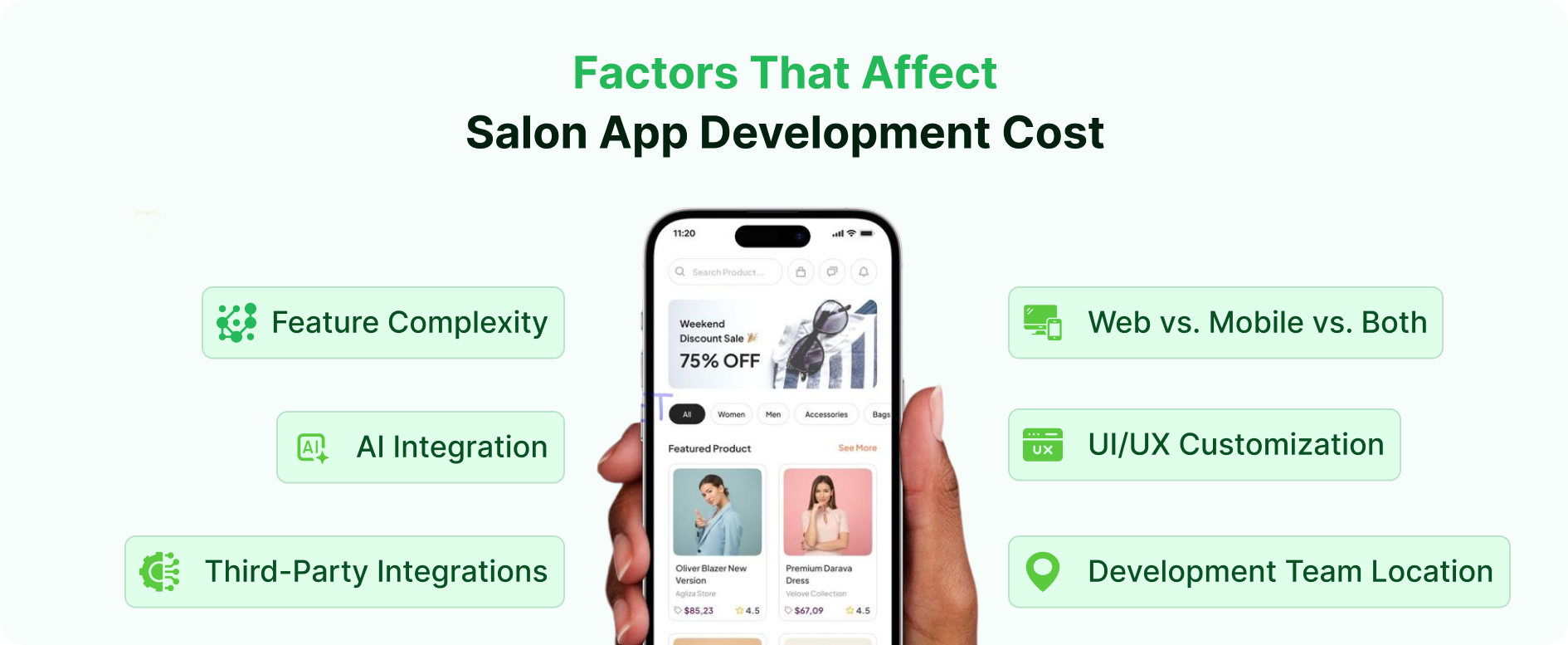
Feature Complexity
A simple appointment calendar costs far less to build than a predictive AI scheduling engine. Every advanced feature requires more development time, testing, and infrastructure.
Web vs. Mobile vs. Both
A web-only platform is the most affordable option. Adding a native iOS and Android app roughly doubles the front-end development work. Many businesses in 2026 need both, which should be budgeted accordingly.
AI Integration
Machine learning models, chatbot development, and predictive analytics require specialized engineers and additional infrastructure. This is typically the largest single cost variable in modern salon platform development.
UI/UX Customization
A generic interface keeps costs lower. A fully custom design that reflects your brand identity, with thoughtful user flows and polished micro-interactions, requires a dedicated design phase that adds both time and budget.
Third-Party Integrations
Integrating your platform with payment processors, Google Maps, WhatsApp Business, accounting software, or marketing tools necessitates tailored API development. An increase in integrations results in a higher number of development hours.
Development Team Location
Teams located in North America or Western Europe typically charge between $100 and $200 per hour. In contrast, teams from Eastern Europe generally range from $50 to $100 per hour.
Development partners from South Asia usually charge between $25 and $60 per hour. The cost for the same set of features can vary significantly based on the geographical location of your team.
Hidden & Ongoing Costs in Salon App Development
The initial construction represents merely a segment of the overall financial landscape. The development of salon management software entails ongoing expenses that every business proprietor must consider in their budget prior to making a commitment.
Hosting and Cloud Services
Whether you’re on AWS, Google Cloud, or Azure, server costs scale with usage. A small salon might pay $100–$300 per month. Enterprise platforms can run $1,000 or more monthly depending on traffic and data storage needs.
SMS and Email Charges
Every automated reminder your system sends costs money. Depending on volume and the provider you use, this can range from a few hundred to several thousand dollars annually.
Payment Gateway Fees
Stripe, PayPal, and similar processors typically charge 2–3% per transaction. For high-volume salons, this becomes a meaningful operational line item.
Maintenance and Updates
Software needs ongoing attention. Bug fixes, security patches, and compatibility updates with new operating systems require a maintenance retainer, typically 15–20% of the original development cost per year.
Feature Upgrades
As your business grows or new technology becomes available, you’ll want to add capabilities. Budget for iterative development rather than treating the launch as a one-time expense.
Final Thoughts: Is It Worth Investing in 2026?
In a crowded marketplace, a salon’s success is no longer defined solely by the skill of its stylists, but by the intelligence of its operations. The modern client doesn’t just want a haircut; they demand a frictionless digital experience—instant booking at 2 AM, a reminder that fits their schedule, and a service that feels curated just for them. In this environment, a clunky, manual booking process isn’t just an inconvenience; it’s a competitive liability.
This is where technology shifts from being a simple utility to a core growth engine. An AI-driven platform does more than just manage appointments; it actively strengthens your business. It transforms a potential “no-show” into a confirmed booking, turns a one-time visitor into a loyal repeat client, and equips your staff with the insights to offer services your customers didn’t even know they wanted. These aren’t just feature upgrades; they are direct levers for profitability. The cumulative effect of filling one extra appointment slot per day or successfully upselling a single treatment can translate into a five-figure swing in annual revenue.
Ultimately, the decision to build a custom platform is an investment in that trajectory. The math is simple: the financial boost from reduced churn, optimized staff time, and increased basket size typically pays for the development cost before the first year is up. By 2026, the competitive gap between salons with intuitive, AI-powered ecosystems and those without will be a chasm.
The question, therefore, is not about the cost of building a platform, but the cost of standing still.
Don’t just compete—lead. Let DevStory help you architect the salon platform that defines the future of your business.


 Enjoy 20% Off All App & Web Services