In the ever-evolving realm of fitness and wellness, effectively managing gym operations is essential for maintaining a successful business. The global fitness industry is stronger than ever. The global health and fitness club market size was valued at USD 121.19 billion in 2024. The market is projected to grow from USD 131.31 billion in 2025 to USD 244.70 billion by 2032, exhibiting a CAGR of 9.30% during the forecast period.
From mobile bookings to AI-powered workout tracking, digital transformation has become a competitive necessity rather than a luxury. Many gyms still rely on manual scheduling and disconnected systems, causing booking errors, billing issues, missed renewals, high churn, and reduced time for member engagement.
Whereas gym management software streamlines member registrations, scheduling, billing, and performance tracking, while offering CRM tools, analytics, mobile integration, automated payments, attendance monitoring, AI-powered recommendations, wearable integration, loyalty programs, and multi-branch management.
In this step-by-step guide, we’ll break down how to build a scalable gym management software — from defining core features and choosing the right tech stack to estimating development costs and timelines. Whether you’re a startup founder entering the fitness tech space or a development team planning a SaaS product, this guide will give you a practical roadmap.
Because when built strategically, scalable gym management software can improve operational efficiency by 40–60%, reduce churn, and unlock new revenue streams. Here’s exactly how to build one the right way.
What Is Gym Management Software?
Gym management software serves as a comprehensive digital solution aimed at automating and optimizing the operations of fitness businesses, encompassing membership management, billing, scheduling, and attendance tracking. Did you know that the Gym Management Software Market expanded from USD 2.03 billion in 2025 to USD 2.23 billion in 2026. It is anticipated to maintain a growth rate of 10.24% CAGR, ultimately reaching USD 4.02 billion by 2032.
These significant changes are urging software providers to rethink their product roadmaps and strategic alliances. To stay ahead in a progressively competitive landscape, industry leaders must emphasize the incorporation of advanced analytics and artificial intelligence into all aspects of their platforms.
Key Features and Benefits
The key features and advantages of gym management software development encompass:
Membership & Member Management: Digital signing of waivers, management of contracts, and tracking of member profiles.
Automated Billing & Payments: Management of recurring payments, dues, and invoicing processes.
Scheduling & Booking: Administration of trainer schedules, class reservations, and facility availability.
Access Control: Integration of RFID and biometric systems to ensure 24/7 access and security.
Reporting & Analytics: Monitoring of revenue, attendance patterns, and retention rates to enhance business performance.
Communication Tools: Automated SMS and WhatsApp messaging for reminders, marketing purposes, and notifications.
Who Makes Use of Gym Management Software?
The gym scheduling software is employed not only by conventional fitness industry sectors. It is also utilized by yoga studios, spas, salons, spin studios, dance studios, gymnastics training centers, and independent personal trainers. This list is not exhaustive; any business sector that centers its operations around class-related or service-related activities can benefit from this application.
The gym scheduling software focuses on areas such as trainer and class scheduling, membership management, milestone tracking, and more.
How to Build a Gym Management Software?
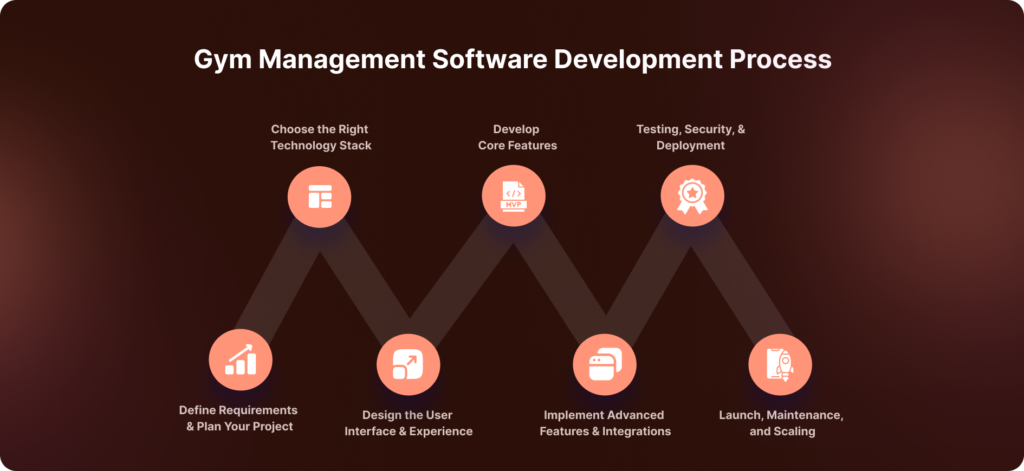
The procedure for developing such a platform encompasses a series of steps that are standard for constructing any software solution. Each step is vital to the overall success, which is why none can be overlooked. Although these phases may vary slightly based on the practices adopted by different software development companies. At DevStory, the complete project execution is structured in the following manner.
Step 1: Define Requirements and Plan Your Project
The foundation of successful gym management software development begins with clearly defining requirements and building a structured project plan. Skipping this stage often leads to scope creep, delayed launches, and unnecessary development costs.
Identify Core User Needs
Start by understanding your primary users:
- Gym Owners & Managers: They need an intuitive admin dashboard with real-time reports, revenue tracking, membership insights, attendance analytics, and multi-branch management.
- Members: A mobile-first experience for class bookings, membership renewals, digital payments, workout tracking, and push notifications.
- Trainers: Access to schedules, client progress tracking, session management, and performance insights.
Mapping these needs early ensures your software solves real operational challenges rather than adding complexity.
Prioritize Key Features: MVP vs Full Build
Avoid building everything at once. Instead, define a Minimum Viable Product (MVP) that includes:
- Member database management
- Class scheduling system
- Billing and subscription management
- Attendance tracking
Advanced features like AI-based workout personalization, loyalty programs, wearable integrations, and in-depth analytics can be added in later phases.
Conduct Market Research
Analyze competitors like Mindbody and Zen Planner to understand feature benchmarks, pricing models, and user experience gaps. Look for opportunities in mobile-first design, automation, and AI-driven personalization.
Project Scope and Planning
For an MVP, expect a development timeline of 3–6 months with a team of 2–5 developers. The gym management software development cost for this phase typically ranges between $20,000 and $80,000, depending on cross-platform requirements (web and mobile), feature complexity, UI/UX standards, and third-party integrations like payment gateways and analytics tools.
Legal & Compliance Considerations
Since gyms handle sensitive member data, ensure compliance with GDPR and CCPA regulations. Secure payment gateway integrations and encrypted data storage are essential for building trust and long-term scalability.
Step 2: Choose the Right Technology Stack
Selecting the right technology stack directly impacts scalability, performance, and overall development costs. A well-planned stack ensures your gym management software remains secure, fast, and future-ready.
Frontend Development
For cross-platform applications, frameworks like React Native and Flutter are strong choices. Both allow you to build mobile and web apps using a single codebase, reducing development time by nearly 30%.
- Flutter: High-performance UI, faster rendering, ideal for visually rich apps.
- React Native: Strong community support, JavaScript-based, easier third-party integrations.
Compared to native iOS and Android development, top cross-platform app development frameworks significantly reduce time-to-market and costs.
Backend Development
For scalable backend architecture, consider:
- Node.js with Express.js for fast, event-driven applications.
- Django for secure, structured, and enterprise-grade systems.
For databases:
- MongoDB (flexible schema for member profiles)
- PostgreSQL (ideal for structured transactional data)
Cloud & Hosting
Cloud platforms like Amazon Web Services (AWS) and Firebase offer scalable hosting, real-time databases, and secure authentication systems.
Key Integrations
- Stripe / PayPal for secure payments
- Twilio for SMS notifications
- Google Calendar API for scheduling
AI & Machine Learning Add-ons
Integrating AI tools like TensorFlow enables personalized workout recommendations, attendance predictions, and churn analysis.
Estimated Cost Comparison
| Tech Approach | Estimated Cost | Best For |
|---|
| Flutter (Cross-Platform) | ~$40,000 | Startups, MVPs |
| React Native (Cross-Platform) | ~$45,000 | Fast scaling |
| Native (iOS + Android) | ~$70,000+ | Enterprise-level apps |
Choosing the right stack balances performance, scalability, and long-term ROI.
Step 3: Design the User Interface and Experience
A powerful gym management system is only as good as its usability. Even the most feature-rich platform will fail if users struggle to navigate it. In gym management software development, UI/UX plays a critical role in user adoption, retention, and overall satisfaction. That’s why modern design must align with evolving UI/UX design trends, focusing on clarity, speed, personalization, and simplicity.
Wireframing & Design Tools
Start with wireframing tools like Figma or Sketch to create structured layouts for both the member app and the admin panel.
For members, design screens such as:
- Dashboard with membership status and upcoming classes
- Booking calendar with available slots
- Notifications and reminders
For admins, focus on:
- Revenue dashboard
- Attendance analytics
- Member management panel
Wireframes help visualize workflows before development begins, reducing costly revisions and development delays.
UX Principles to Follow
Adopt a mobile-first approach, since most members book classes and track workouts through smartphones. Navigation should be intuitive — enabling one-tap bookings, fast renewals, and seamless payment flows.
Accessibility is equally important. Use readable typography, proper color contrast, minimalistic layouts, and clear CTAs to ensure inclusivity across age groups and tech skill levels.
Key Screens to Prioritize
Your MVP should include:
- Member profile with subscription details
- Class scheduler with trainer information
- Payment history and invoices
- Trainer portal for session and client tracking
Prototyping & User Testing
Develop interactive prototypes and test them with real gym owners and staff. Collect feedback, refine user flows, and iterate quickly. Early validation ensures your software aligns with real-world operational needs and enhances long-term product success.
Step 4: Develop Core Features
Developing core modules is the most critical stage in any software for gym management projects. At this point in this gym management software guide, the focus shifts from planning to execution. These core systems must be secure, automation-driven, and built with application scalability in mind—especially if your goal is to build a successful mobile app for your startup in the competitive fitness-tech market.
The Member Management Module serves as the central database of your system. It stores and organizes member information while enabling personalized engagement and streamlined administration.
Begin with secure user registration and login functionality. Implement OAuth authentication (Google or Apple login) for quick onboarding, along with biometric authentication (Face ID or fingerprint) for mobile convenience and enhanced security.
Each member profile should include:
- Personal details
- Membership tier and renewal dates
- Attendance history
- Assigned trainer
- Workout progress tracking
- Payment status
Progress tracking can include body measurements, performance logs, fitness goals, and session history. This not only improves engagement but also allows trainers to deliver personalized plans.
Admins should be able to filter members by active, expired, or pending status. Role-based access control and encrypted data storage are essential for security compliance.
Design this module with scalability in mind. As your gym grows or expands to multiple branches, the system should handle thousands of member records without performance issues.
Scheduling and Booking System
A real-time Scheduling and Booking System eliminates manual coordination and reduces front-desk dependency.
Implement a dynamic calendar that displays:
- Trainer availability
- Class capacity
- Room allocation
- Available time slots
Members should be able to book sessions instantly through a mobile interface with one-tap confirmation. Automated notifications via email, push alerts, or SMS should confirm bookings and remind users before class time.
Adding a waitlist feature ensures maximum occupancy. If someone cancels, the next member automatically receives a notification. QR-based check-ins can simplify attendance tracking and eliminate manual errors.
Admins must have the flexibility to reschedule classes, assign substitute trainers, or block unavailable slots. Calendar syncing enhances convenience by allowing members to add bookings to personal calendars.
For long-term application scalability, ensure the booking engine can handle peak traffic during popular time slots without crashes or slowdowns.
Payment and Billing Module
The Payment and Billing module ensures stable revenue flow and financial transparency. It should support both recurring subscriptions and one-time payments for personal training, merchandise, or special classes.
Recurring billing automation enables seamless monthly or annual charges. Secure tokenization protects payment data while ensuring compliance with global security standards.
Key features should include:
- Automated invoicing
- Payment reminders
- Failed transaction alerts
- Refund processing
- Promo code and discount management
- Multi-currency support
Members should have access to a payment history dashboard where invoices can be downloaded anytime. This increases transparency and reduces disputes.
Admins should view revenue analytics, subscription reports, tax summaries, and pending payments in real time. Integration with accounting software further simplifies financial management.
To successfully build a successful mobile app for your startup, your billing infrastructure must be reliable, scalable, and capable of handling increasing transaction volumes as your business grows.
Step 5: Implement Advanced Features and Integrations
After building the core modules, the next step in developing advanced software for gym management is integrating intelligent features that enhance automation, engagement, and business intelligence. These enhancements transform your platform from a basic operational system into a data-driven fitness ecosystem.
Analytics Dashboard
A powerful analytics dashboard helps gym owners make informed decisions. Using visualization libraries like Chart.js, you can present complex data in simple graphical formats.
Important metrics to track include:
- Member retention rate
- Monthly recurring revenue (MRR)
- Attendance patterns
- Trainer performance
- Churn analysis
- Peak usage hours
Interactive graphs and performance indicators enable quick insights into growth opportunities and operational inefficiencies.
AI Enhancements
Artificial Intelligence in mobile app development adds significant competitive value. By integrating the OpenAI API, your system can generate personalized workout plans based on user fitness goals, body metrics, and training history.
AI can also support:
- Smart workout recommendations
- Nutrition suggestions
- Automated engagement scoring
- Churn prediction models
Predictive analytics allows gyms to proactively retain members by offering targeted promotions or personalized communication.
IoT & Wearable Integration
To create a connected fitness experience, integrate wearables like Fitbit and Apple Health. This enables real-time syncing of steps, calories burned, heart rate, and workout sessions. Such integrations increase personalization and improve progress tracking accuracy.
Push Notifications & In-App Communication
With Firebase, you can implement real-time push notifications and in-app messaging. Automated reminders for classes, renewals, and promotions boost engagement and reduce missed sessions.
Security & Compliance
Advanced software for gym management must prioritize security. Implement role-based access control, end-to-end encryption, secure APIs, and PCI-compliant payment systems to safeguard financial and health-related data. Strong security practices not only ensure compliance but also build long-term trust and scalability.
Step 6: Testing, Security, and Deployment
Before launching your software for gym management, thorough testing and strong security implementation are critical. A stable and secure product ensures performance reliability, protects user data, and builds long-term trust. Remember, mobile app security is important for your business, especially when handling sensitive health data and financial transactions.
Testing Phases
Start with unit testing to validate individual components. Tools like Jest help automate frontend and backend logic testing efficiently.
Next comes integration testing, ensuring modules such as payments, scheduling, and notifications work seamlessly together. After that, conduct User Acceptance Testing (UAT) with real gym owners and staff to validate workflows.
Load testing is equally important. Simulate scenarios like 1,000+ concurrent users booking classes or making payments to ensure the system handles peak traffic without crashes or slowdowns. Performance optimization at this stage prevents costly post-launch fixes.
Security Best Practices
Follow the guidelines from OWASP top security risks to prevent vulnerabilities such as SQL injection, broken authentication, and insecure APIs.
Key security measures include:
- Role-based access control
- Encrypted data storage (AES-256)
- Secure HTTPS communication
- Regular security audits and penetration testing
- PCI compliance for payment modules
Strong security protects both your brand reputation and user trust.
Deployment Strategy
Implement CI/CD pipelines using GitHub Actions to automate builds, testing, and deployments. This reduces human error and accelerates release cycles. For mobile apps, prepare for submission to Apple App Store and Google Play, ensuring compliance with platform guidelines.
Monitoring & Maintenance
After deployment, continuous monitoring is essential. Tools like Sentry and New Relic help track crashes, API errors, and performance bottlenecks in real time. Ongoing monitoring ensures your software remains scalable, secure, and ready for growth.
Step 7: Launch, Maintenance, and Scaling
After completing development, the next phase in gym management software development is launching strategically and preparing for long-term growth.
Go-to-Market Strategy
Start with a beta launch by partnering with a few local gyms. This allows you to gather real-world feedback, identify usability gaps, and refine performance before a full-scale rollout. Promote your app through the Apple App Store and Google Play Store with optimized descriptions, screenshots, and reviews. Additionally, leverage LinkedIn marketing, fitness communities, and targeted digital ads to reach gym owners and fitness entrepreneurs. Offer limited-time discounts or free onboarding support to encourage early adoption.
Post-Launch Optimization
Launch is just the beginning. Continuously monitor performance, fix bugs quickly, and release regular feature updates. Establish user feedback loops through in-app surveys, reviews, and direct communication with gym owners. This ensures your product evolves based on real customer needs rather than assumptions. Track key metrics such as retention rate, churn, monthly recurring revenue, and feature usage to guide future improvements.
Scaling for Growth
As user numbers grow, shift toward microservices architecture to improve flexibility and system resilience. Serverless infrastructure can help optimize operational costs while handling traffic spikes efficiently. If you want to accelerate innovation and ensure long-term scalability, it’s always smart to hire software development team with proven expertise in scalable SaaS platforms.

Gym Management Software Development Cost
Understanding the cost to develop gym software is essential before starting your project. The overall gym management software development cost depends on multiple technical and business factors, including feature complexity, platform choice, integrations, and scalability requirements. Whether you’re building an MVP or a full-scale SaaS platform, careful budgeting ensures sustainable growth and better ROI.
1. Feature Complexity ($20,000 – $60,000+)
Core features like member management, scheduling, and billing require moderate investment. However, adding AI-powered recommendations, analytics dashboards, wearable integrations, and multi-branch support significantly increases development hours. The more automation and personalization you include, the higher the development cost and timeline.
2. Platform Selection ($15,000 – $40,000)
Choosing between cross-platform (Flutter/React Native) and native iOS + Android impacts pricing. Cross-platform apps reduce duplication of effort and lower costs, while native apps offer deeper device optimization but require separate development teams, increasing overall expenses.
3. UI/UX Design Requirements ($5,000 – $15,000)
Custom UI/UX design tailored for gym owners, trainers, and members improves adoption but adds cost. Advanced dashboards, interactive analytics, and mobile-first experiences require additional design research, prototyping, and testing cycles.
4. Third-Party Integrations ($5,000 – $20,000)
Integrating payment gateways, SMS notifications, wearable devices, CRM tools, and accounting systems adds complexity. API development, testing, and compliance (PCI, GDPR) influence the overall gym management software development cost significantly.
5. Infrastructure & Scalability ($10,000 – $30,000 annually)
Cloud hosting, database management, security layers, load balancing, and ongoing maintenance contribute to long-term operational expenses. If you expect thousands of active users, investing in scalable architecture increases upfront and recurring costs.
In summary, the cost to develop gym software typically ranges between $20,000 and $150,000+, depending on scope, scalability, and customization level. Careful planning and phased development can help control your overall investment.
Conclusion
Building a gym management platform is more than a tech investment—it’s a strategic growth move. A well-designed system can reduce administrative workload by up to 50%, improve operational efficiency, automate billing, streamline scheduling, and significantly boost member retention. With data-driven insights and automation, gym owners can focus more on delivering exceptional fitness experiences rather than handling manual tasks.
To get started, focus on launching a lean MVP with essential modules like member management, scheduling, and billing. Use a clear tools checklist—cross-platform framework, scalable backend, secure payment gateway, analytics, and cloud hosting—to ensure a smooth development journey.
For faster ROI and long-term scalability, consider outsourcing to experts like Dev Story, a premium mobile application development company with experience in building secure, high-performance fitness applications tailored for growth.


 Enjoy 20% Off All App & Web Services