The real estate industry is undergoing a profound digital transformation. From automated rent collection to AI-driven tenant screening, technology is reshaping how property managers operate, communicate, and grow.
Henceforth, property management businesses are investing in software now more than ever because of its efficiency, scalability, and tenant expectations. Modern renters demand real-time communication, online payments, and digital maintenance requests. Property managers need tools that handle growing portfolios without adding proportional overhead. The result is a surge in demand for purpose-built platforms — and a natural question that follows: what does it actually cost?
Property management software pricing varies significantly depending on the scope, features, and development approach. A basic solution can start around $20,000, while enterprise-grade platforms with advanced integrations can exceed $150,000. Understanding what drives these numbers is key to making an informed investment decision.
This guide covers everything you need to know on how much does property management software cost? Get a detailed cost breakdown by software type and development approach, the key factors that affect pricing, hidden costs to watch for, development timelines, and how DevStory a leading real estate app development company builds world-class property management solutions. Whether you are a startup, a growing agency, or an enterprise, this resource will help you plan your investment wisely.
Property Management Software Market Overview
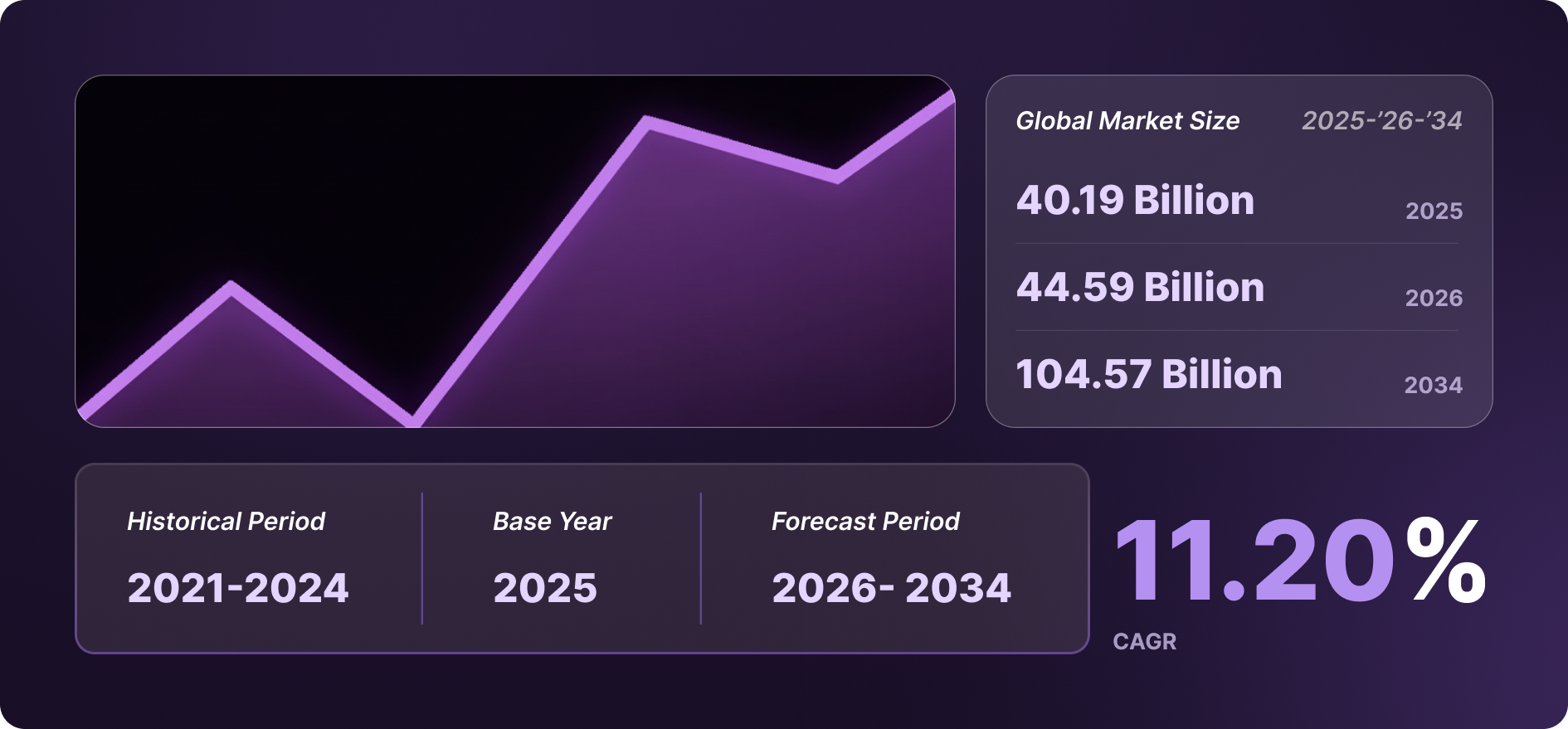
According to Fortune Business Insights, the global PropTech market was valued at USD 40.19 billion in 2025 and is expected to grow from USD 44.59 billion in 2026 to USD 104.57 billion by 2034, registering a CAGR of 11.9% during the forecast period.
Driven by increasing urbanization, portfolio expansion, and the widespread adoption of cloud-based platforms, investors and operators alike are recognizing that digital infrastructure is no longer optional — it is a competitive necessity.
The rise of AI in real estate, tenant self-service portals, and mobile-first platforms is reshaping the user experience. Landlords want predictive analytics, occupancy forecasting, and automated compliance tools. These expectations are driving the next generation of feature-rich platforms.
2026 is a particularly strong year to invest in property management software development. Technology costs have stabilized, offshore development teams are highly skilled and accessible, and the ROI on automation is increasingly measurable. Businesses that build now will be positioned ahead of the curve as the market continues to consolidate around digital-first operators.
How Much Does Property Management Software Development Cost?
The projected development cost for property management software starts at $5,000. Nevertheless, various additional elements, such as the software’s complexity, features, technology stack, and design, influence its development cost. Let us thoroughly examine the factors outlined below to gain insight into the property management software development cost.
Cost Range Overview
One of the most common questions from real estate businesses is: how much does property management software cost? Here is a broad overview:
Basic Software ($20,000 – $40,000): Covers essential features such as tenant management, rent collection, and basic reporting. Suitable for small landlords or agencies managing fewer than 50 units.
Mid-Level Solution ($40,000 – $80,000): Includes multi-user roles, maintenance tracking, integrated accounting, and a tenant portal. Ideal for growing agencies managing multiple properties.
Advanced Enterprise-Grade System ($80,000 – $150,000+): Features AI integrations, IoT support, advanced analytics, mobile apps, and complex third-party integrations. Built for large portfolios or commercial operators.
Cost Based on Development Approach
Understanding property management software development cost also requires evaluating your development approach:
Custom-Built Software — $40,000 to $150,000+
Built entirely to your specifications, you own the codebase with no licensing fees or vendor lock-in. The investment covers full engineering: architecture, development, QA, and deployment. A mid-sized rental platform lands between $40,000 and $80,000; enterprise-grade systems with advanced integrations exceed $150,000.
Best for: Growing agencies and enterprise operators with unique workflows.
SaaS-Based White-Label — $5,000 to $25,000 setup + $300 to $1,500/month
Rebrand and deploy an existing platform in weeks. Fast and affordable upfront, but you never own the codebase. Subscription fees compound quickly — a $500/month plan costs $18,000 over three years, often matching a custom MVP cost but without ownership or flexibility.
Best for: Startups testing a concept or small operators managing fewer than 30 units
MVP vs Full-Scale Platform — MVP: $20,000 to $45,000 | Full Build: $60,000 to $150,000+
An MVP launches with three to five core features and is 40–60% cheaper than a full build. It validates your product with real users within three to four months. A full-scale platform adds all user roles, integrations, mobile apps, and automation. Launch MVP first, then fund the full build from early revenue.
Best for: First-time builders and funded startups wanting to reduce risk before full investment.
Offshore vs In-House Development
This is where real estate app development cost varies most dramatically.
| Development Model | Hourly Rate | Est Project Cost |
|---|
| US / UK In-House | $100 – $180/hr | $120,000 – $200,000 |
| Western Europe | $70 – $120/hr | $90,000 – $150,000 |
| Eastern Europe | $40 – $70/hr | $50,000 – $85,000 |
| South Asia | $20 – $45/hr | $25,000 – $55,000 |
Offshore teams offer 40–60% savings with comparable quality — when you choose an agency with strong project management, clear communication, and a verified delivery track record.
Best for: Businesses with defined scope and a reliable offshore development partner.
Bottom Line: Match the approach to your business stage. A startup should not spend $150,000 on an enterprise build. A scaling operator should not rely on a platform they do not own. Hiring a software development team and choosing the right approach can be the single biggest lever in controlling your real estate software development cost without compromising on quality or long-term potential.
Cost Breakdown by Software Type
Not all property management platforms are the same. The type of software you build will directly influence your budget. Here is a breakdown of typical costs by software category:
Rental Property Management Software ($25,000 – $70,000)
Designed for residential landlords and rental agencies, this type covers tenant onboarding, lease tracking, online payments, and maintenance requests. Costs rise with the number of units managed and the level of automation required.
Commercial Property Management System ($50,000 – $130,000)
Commercial property management software cost tends to be higher due to the complexity of multi-tenant billing, CAM (common area maintenance) reconciliation, lease abstraction, and compliance tracking. Expect more robust reporting and integration requirements.
HOA Management Software ($20,000 – $60,000)
Homeowners’ association platforms typically include member portals, dues collection, meeting management, and violation tracking. They are generally less complex than commercial systems but require strong communication and document management features.
Vacation Rental Management Platform ($30,000 – $80,000)
These platforms require dynamic pricing engines, channel management (Airbnb, Booking.com), guest communication automation, and cleaning schedule coordination. Integration complexity drives the cost upward.
Real Estate Portfolio Management Software ($60,000 – $150,000+)
Built for investors and large operators managing diverse asset classes, these platforms require advanced financial modelling, multi-currency support, document management, and deep analytics. They represent the highest tier of real estate software development cost.
Factors Affecting Property Management Software Development Cost
When businesses ask how much property management software costs, the honest answer is: it depends. The final number is not arbitrary — it is the sum of deliberate technical and business decisions made at every stage of development. Understanding these cost drivers gives you the power to make smarter trade-offs, prioritize features with the highest ROI, and avoid budget overruns. Below is a detailed breakdown of every major factor that shapes real estate software development cost, with realistic cost ranges and the reasoning behind each figure.
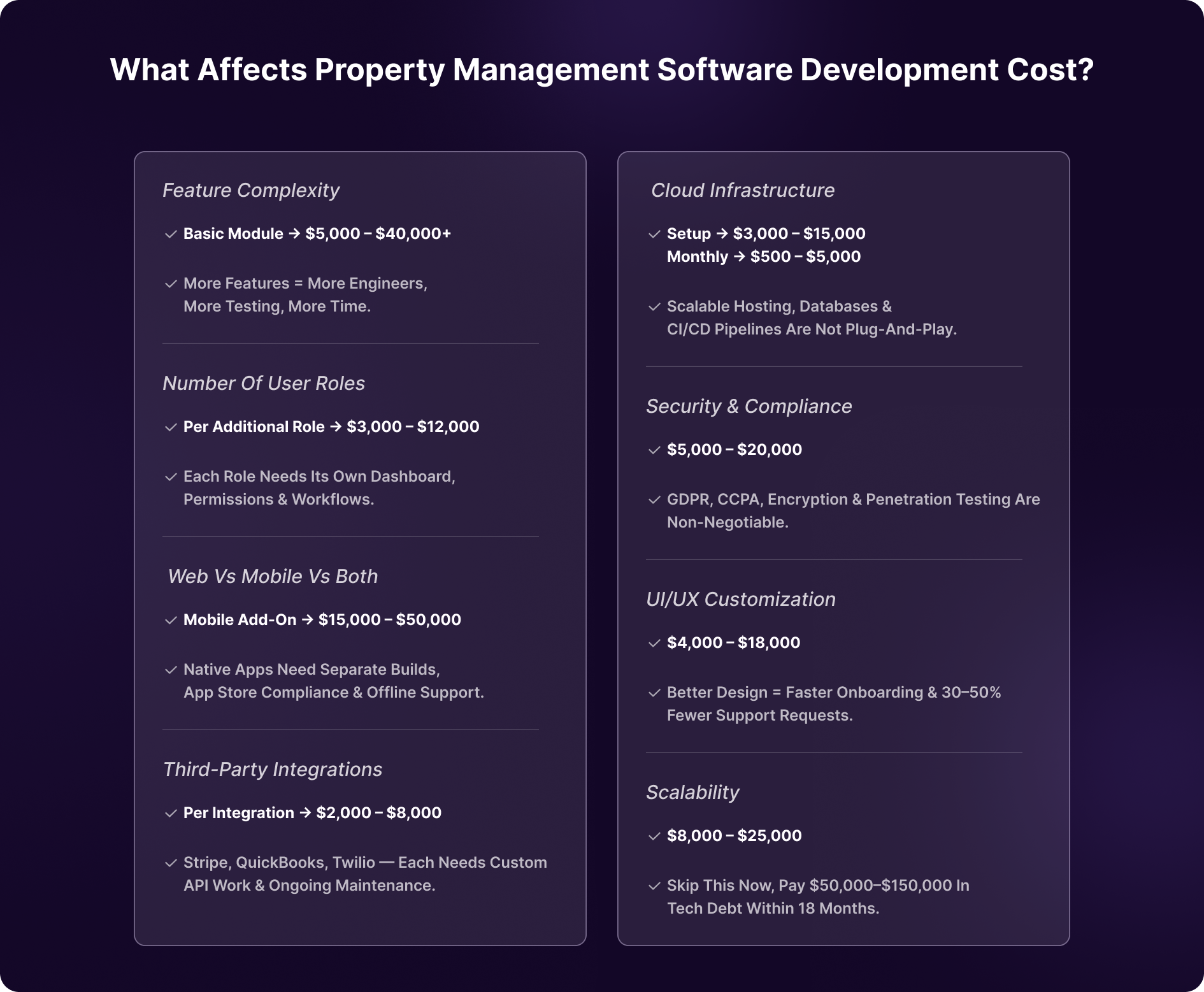
1. Feature Complexity — $5,000 to $40,000+ per module
Simple features like rent tracking or basic dashboards require standard logic and take one to two weeks per module. Advanced features — AI rent prediction, dynamic pricing engines, or IoT smart building controls — require machine learning pipelines, third-party data feeds, and specialized engineers. Each added layer of logic multiplies QA time, API surface area, and maintenance overhead. A platform with five core features costs a fraction of one with fifteen or more interconnected modules. Feature complexity is, by far, the single biggest lever on your total property management software development cost.
2. Number of User Roles — $3,000 to $12,000 per additional role
Every user role — tenant, landlord, admin, maintenance staff — demands its own dashboard layout, permission logic, data access rules, and notification flows. A single-role system is architecturally simple. A four-role platform quadruples the UI design scope and requires a robust role-based access control (RBAC) system on the backend. Each role also multiplies testing scenarios, which adds to QA time and overall cost. The more granular the access hierarchy, the more complex the architecture beneath it.
3. Web vs Mobile vs Both — Mobile adds $15,000 to $50,000 above web baseline
A web-only platform uses a single codebase and browser environment. A native mobile app for iOS and Android requires separate builds, platform-specific UX patterns, App Store compliance, push notification infrastructure, and offline data handling. Top Cross-platform frameworks like React Native reduce this gap to roughly 25–35% above web cost. However, native builds with full hardware access — camera, GPS, biometrics — push costs significantly higher. For most property management businesses, a mobile-responsive web app is the smartest starting point before committing to native app investment.
4. Third-Party Integrations — $2,000 to $8,000 per integration
Each third-party connection — Stripe for payments, QuickBooks for accounting, Plaid for bank linking, Twilio for SMS, or a background-check API — requires dedicated API research, authentication setup, webhook handling, error management, and regression testing. Poorly documented or legacy APIs can triple the integration time. Every integration also introduces an ongoing dependency that must be maintained as an external APIs version and evolve. Businesses planning five or more integrations should factor this as a significant line item in their real estate software development cost.
5. Cloud Infrastructure and Hosting — $3,000 to $15,000 setup, plus $500 to $5,000 per month ongoing
Setting up a production-grade cloud environment on AWS, Azure, or Google Cloud involves VPC configuration, auto-scaling groups, database clustering, CDN setup, and CI/CD pipeline implementation. This is not plug-and-play — it requires a dedicated DevOps engineer. Ongoing costs scale directly with active users and data volume. Cutting corners on infrastructure leads to downtime, data loss, and expensive emergency re-architecture later. The monthly operational cost is a hidden but significant component of total property management software pricing that many first-time buyers overlook.
6. Security and Compliance — $5,000 to $20,000 depending on regulatory scope
Property management platforms handle deeply sensitive data — Social Security numbers, bank details, background check results, and financial transactions. Meeting GDPR, CCPA, or regional housing regulations requires end-to-end encryption, audit logging, data retention policies, and regular penetration testing. SOC 2 compliance preparation alone can add $10,000 to $20,000 to a project. Non-compliance risks regulatory fines and reputational damage that dwarf the cost of building it correctly from the start. This is one area where underinvestment consistently leads to the most expensive outcomes.
7. UI/UX Customization — $4,000 to $18,000 depending on depth
A generic template-based UI can be applied quickly and cheaply. A fully custom-branded interface with user research, persona-based wireframing, interactive prototyping, and a complete design system takes three to five weeks of dedicated design work. Investment in UX pays real dividends — better design reduces onboarding time, lowers tenant support requests by 30–50%, and improves overall platform retention. When evaluating commercial property management software cost, businesses often underestimate how directly UX quality affects post-launch operational savings.
8. Scalability Requirements — $8,000 to $25,000 in additional engineering cost
Building for scale from day one means choosing microservices over a monolith, implementing message queues, designing for horizontal database scaling, and load testing at ten times expected traffic. This upfront investment is significantly cheaper than re-architecting a live system under real user load. Businesses that skip scalability planning often face $50,000 to $150,000 in technical debt resolution within 18 months of launch. If growth is part of your strategy, scalability is not optional — it is foundational.
9. Maintenance and Post-Launch Support — 15% to 20% of initial build cost annually
After launch, software requires continuous attention: bug fixes, OS and library updates, API version migrations, security patches, and performance optimization. For a $60,000 platform, budget $9,000 to $12,000 per year in baseline maintenance. Adding new features resets this cycle. Businesses that plan for maintenance from the start avoid emergency costs and keep the platform competitive as tenant expectations and market standards continue to evolve.
Key Insight: No two projects have identical cost profiles. The most effective approach is to map your specific requirements against each of these factors before requesting a development quote — this ensures your property management software development cost reflects the true scope of your vision, not a generic estimate.
Pro Tip: Starting with an MVP covering three to four core features and two user roles can reduce your initial property management software cost by 50–60%, while allowing you to validate the product with real users before committing to full-scale development.
Key Features of Property Management Software (Cost-Impact Oriented)
The scope and complexity of features directly determine the development budget. Basic operational modules keep costs moderate, while automation, AI, and integrations significantly increase investment due to advanced engineering and infrastructure requirements. Here is how features map to development cost:
Core Features (Lower Cost Impact)
- Tenant & Lease Management: Adds cost through database structuring, role-based access control, and dashboard development for multiple user types.
- Online Rent Collection: Increases budget due to secure payment gateway integration, compliance requirements, and transaction testing.
- Maintenance Request Tracking: Requires workflow logic, notification systems, and admin panels — adding backend and frontend development time.
- Accounting & Financial Reporting: More complex reporting and financial calculations require custom logic and integration with accounting tools, raising costs.
- Document Management: Secure cloud storage, file encryption, and permission settings increase infrastructure and security development expenses.
Advanced Features (Higher Cost Impact)
- AI-Powered Rent Prediction: Requires data scientists, machine learning models, training datasets, and ongoing optimization — significantly increasing development costs.
- Automated Workflows & Smart Alerts: Complex rule-based engines and multi-trigger automation systems demand additional backend architecture.
- IoT Smart Building Integration: Hardware APIs, real-time syncing, and device compatibility testing greatly expand technical scope and cost.
- Real-Time Analytics Dashboard: Custom data processing pipelines and advanced visualizations increase engineering effort and infrastructure expenses.
- Mobile App with Push Notifications: Separate mobile development, app store deployment, and ongoing updates substantially raise overall commercial property management software cost.
Hidden Costs You Should Not Ignore
Many businesses focus on the upfront property management software development cost and overlook the ongoing expenses that accumulate after launch. Ignoring these can seriously derail your ROI projections. Here are the hidden costs to plan for:
- App Store Fees: Publishing on the Apple App Store requires a $99/year developer fee. Google Play charges a one-time $25 registration fee. Both platforms take a percentage of in-app purchases.
- Ongoing Server Costs: Cloud hosting on AWS or Azure is not a one-time expense. Depending on traffic and data storage, monthly costs can range from a few hundred to several thousand dollars as your user base grows.
- API Subscription Costs: Third-party services like Twilio (SMS), SendGrid (email), Plaid (banking), or Stripe (payments) charge usage-based fees that grow with platform adoption.
- Data Migration: Moving existing property, tenant, and financial data from legacy systems or spreadsheets into your new platform requires dedicated engineering time and careful validation.
- Training and Onboarding: Getting staff, landlords, and tenants comfortable with the new platform takes structured training programs, documentation, and support resources.
- Compliance Upgrades: Changing housing regulations, GDPR updates, or regional tenancy laws may require periodic platform modifications to maintain legal compliance.
- Version Upgrades: As your operating system, third-party libraries, and integrations evolve, periodic version upgrades are needed to keep the platform secure, performant, and compatible.
Budgeting for these hidden costs upfront ensures a smoother long-term experience and a more accurate view of your total cost of ownership.
Development Timeline Breakdown
Timeline and cost to build property management software are directly linked — every additional week of development translates to additional investment. Here is a realistic breakdown of what a full development cycle looks like:
Planning & Research
This phase typically consumes 10–15% of the total project budget. Costs arise from business analysis, stakeholder workshops, competitor research, technical consulting, and architecture planning. Skipping this stage often leads to expensive scope changes later.
UI/UX Design
Design usually accounts for 15–20% of overall development costs. Expenses include wireframing, prototyping, user journey mapping, and multi-role interface design. Complex dashboards, tenant portals, and mobile responsiveness increase design investment.
Development
The largest cost component, often 40–55% of the total budget. Expenses depend on backend complexity, number of user roles, database architecture, third-party integrations, and whether mobile applications are included.
Testing & Quality Assurance
Typically 10–15% of total costs. Functional testing, security audits, performance optimization, and cross-device validation require dedicated QA resources, especially for enterprise-grade platforms handling financial transactions.
Deployment & Infrastructure Setup
Costs include cloud hosting configuration, CI/CD pipeline setup, server provisioning, and data migration. Ongoing infrastructure and monitoring expenses continue post-launch, impacting long-term operational budgets.
In total, a full-featured platform can take anywhere from 5 to 9 months from discovery to launch. An MVP approach can cut this to 3–4 months, allowing faster time to market while keeping costs manageable.
Conclusion
Understanding property management software pricing is the first step toward building a platform that truly serves your business. As this guide has shown, the cost to build property management software depends on a wide range of factors — from feature scope and user roles to integrations, cloud infrastructure, and ongoing maintenance. There is no universal answer, but there is always a right answer for your specific situation.
A well-built platform reduces operational overhead, improves tenant retention, accelerates rent collection, and enables portfolio growth without proportional headcount increases. The ROI, measured over three to five years, consistently outweighs the upfront development expenditure.
Whether you are building a rental management tool, a commercial property management system, or a full-scale real estate portfolio platform, the path forward starts with a clear-eyed consultation. At DevStory, we help businesses like yours move from idea to market-ready product with precision, transparency, and a relentless focus on results.
Ready to explore what your platform could cost? Contact us today for a free consultation and custom project estimate.


 Enjoy 20% Off All App & Web Services